
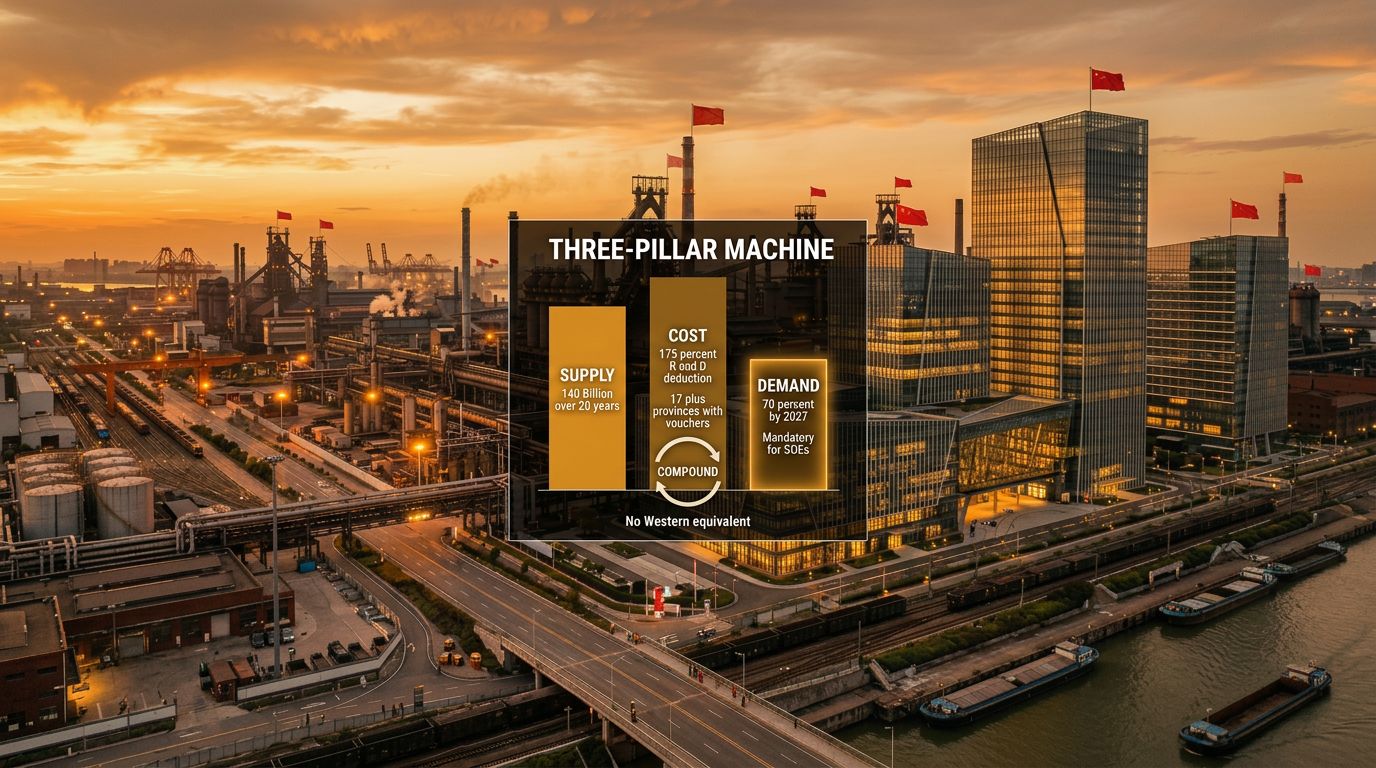
A three-pillar incentive architecture with no Western equivalent
A three-pillar incentive architecture with no Western equivalent
China's AI incentive system isn't just subsidies or investment — it's an integrated machine. State capital funds the supply side ($8.3B national AI fund, $140B over 20 years). Multi-layered subsidies lower costs at every layer (compute vouchers in 17+ provinces, 50% electricity subsidies, 175% R&D super deductions). And regulatory mandates guarantee demand (70% AI penetration by 2027, mandatory for SOEs). The three pillars compound.
Editor's Insight
The EU has Pillar 1 partially. The US has none of the three — its AI leadership rests entirely on private capital and market dynamics.
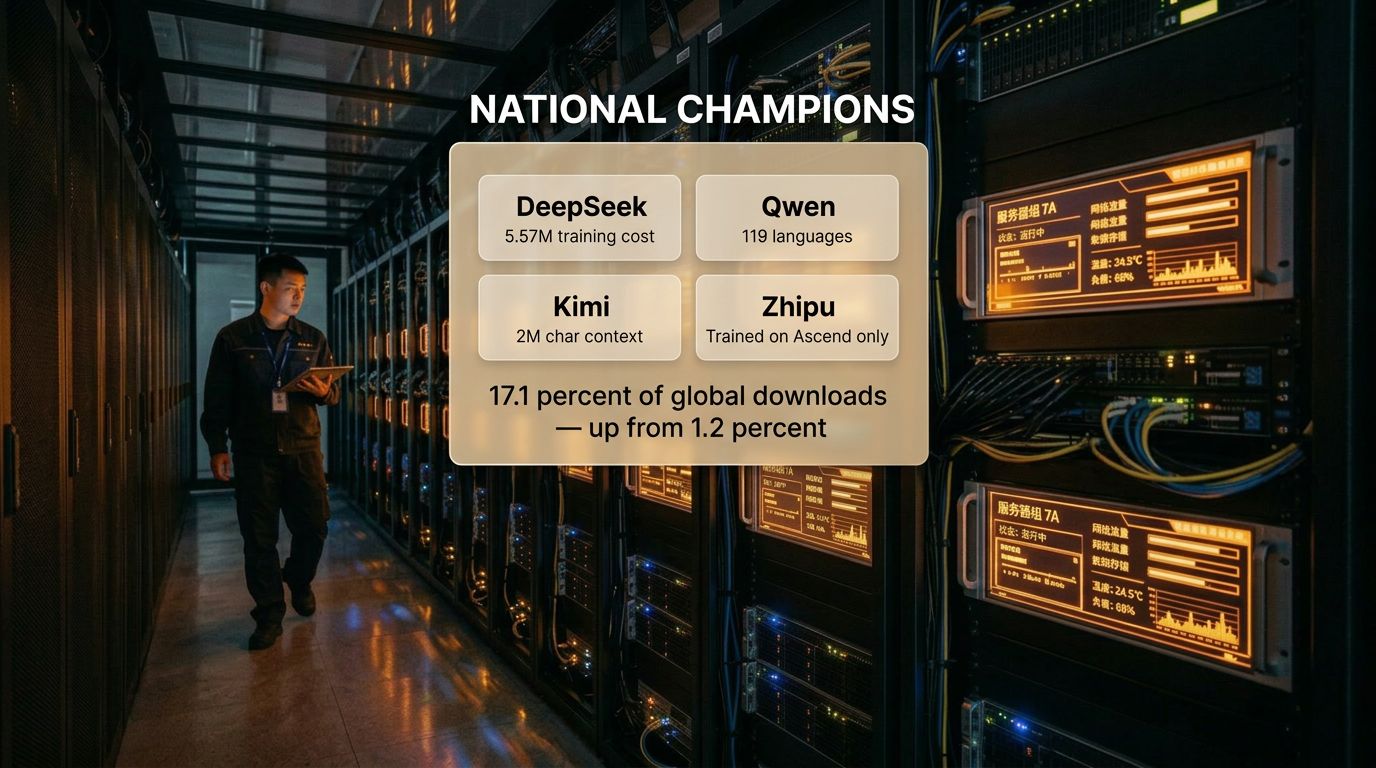
DeepSeek, Qwen, Kimi, and Zhipu are solving different problems
DeepSeek, Qwen, Kimi, and Zhipu are solving different problems
DeepSeek V3.2 trained for $5.57M at gold-medal AIME level. Zhipu's GLM-Image trained entirely on Huawei Ascend — no Nvidia, no CUDA. Open-source share jumped from 1.2% to 17.1% of global downloads. This isn't altruism — it's a competitive weapon building developer dependency.
Editor's Insight
The open-source strategy contrasts sharply with America's API-only, cloud-locked model. China is building global dependency while the US is building walled gardens.
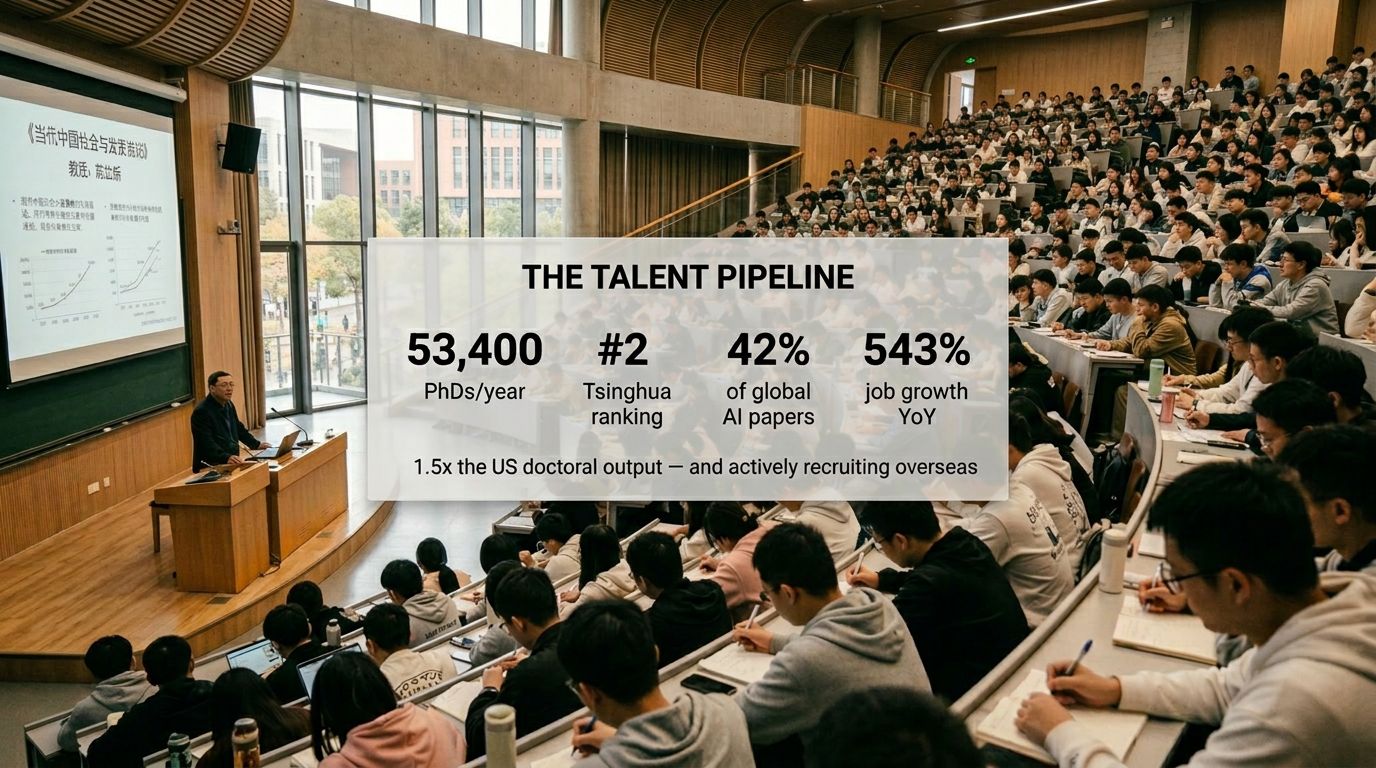
Four Chinese universities now outpublish MIT and Stanford in AI
Four Chinese universities now outpublish MIT and Stanford in AI
Tsinghua ranks #2 globally for AI conference publications, surpassing MIT and Stanford. China produced 23,695 AI papers in 2024 — 42% of global output, matching the combined output of the US, UK, and EU-27. The talent pipeline extends beyond organic production: the Qiming Plan offers overseas PhDs up to 5 million yuan in salary subsidies, and AI job openings grew 543% year-over-year in 2025.
Editor's Insight
The citation gap in patents (7x fewer than US) raises the question of whether a similar quality gap exists in academic output.
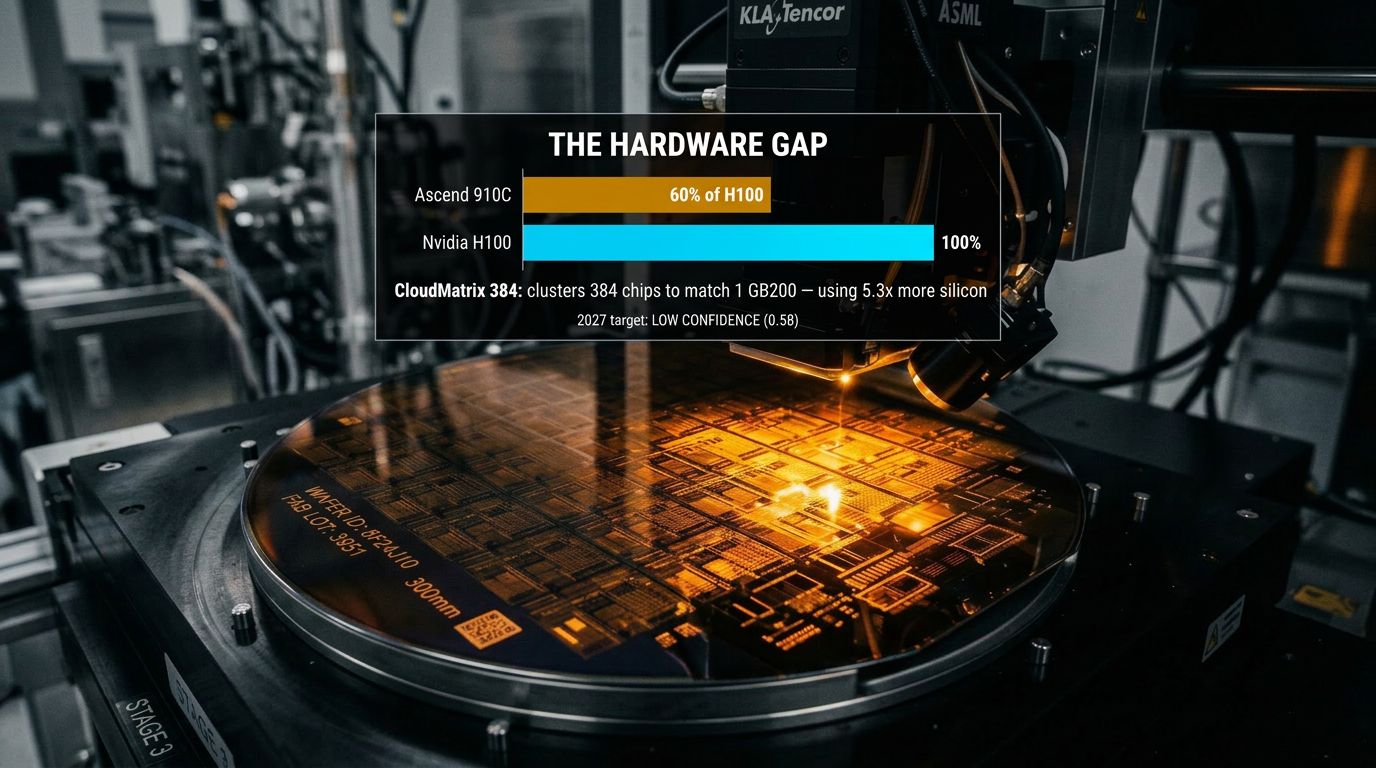
Huawei's Ascend chips work — just not for everything
Huawei's Ascend chips work — just not for everything
Huawei's Ascend 910C performs at roughly 60% of the Nvidia H100 according to DeepSeek researchers — far below Huawei's marketing claim of 8-12% behind. DeepSeek tried Ascend for their flagship model and found results 'unacceptable.' But Zhipu's GLM-Image trained successfully on Ascend, proving the domestic stack works for some workloads. The CloudMatrix 384 system clusters 384 Ascend 910C chips with a pooled-memory architecture, trading per-chip performance for aggregate scale — a workaround, not a fix.
Editor's Insight
The 2027 chip independence target carries low confidence. Current realities — 75% Nvidia dependence, sub-30% yields at SMIC — suggest the target will be redefined rather than achieved.
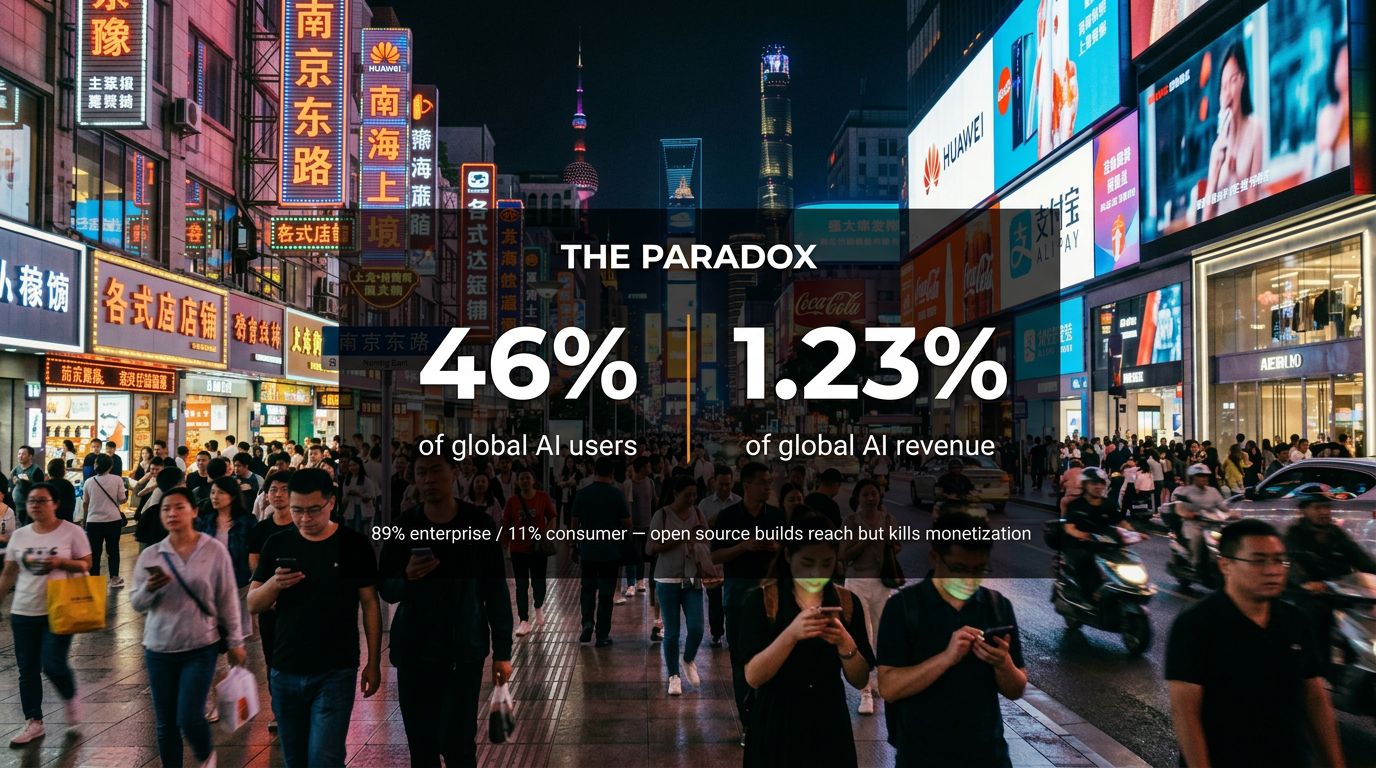
46% of AI users, 1.23% of AI revenue
46% of AI users, 1.23% of AI revenue
Chinese platforms account for 46% of global AI monthly active users but capture just 1.23% of top 100 AI company revenue. Revenue splits 89% enterprise, 11% consumer. The open-source strategy builds reach but complicates monetization — a tension that mirrors the broader patent paradox where China holds 70% of AI patents but receives 7x fewer citations per patent than the US.
Editor's Insight
The deployment strength is industrial, not digital. Automated ports show what the model produces. The open question is whether it can produce revenue.
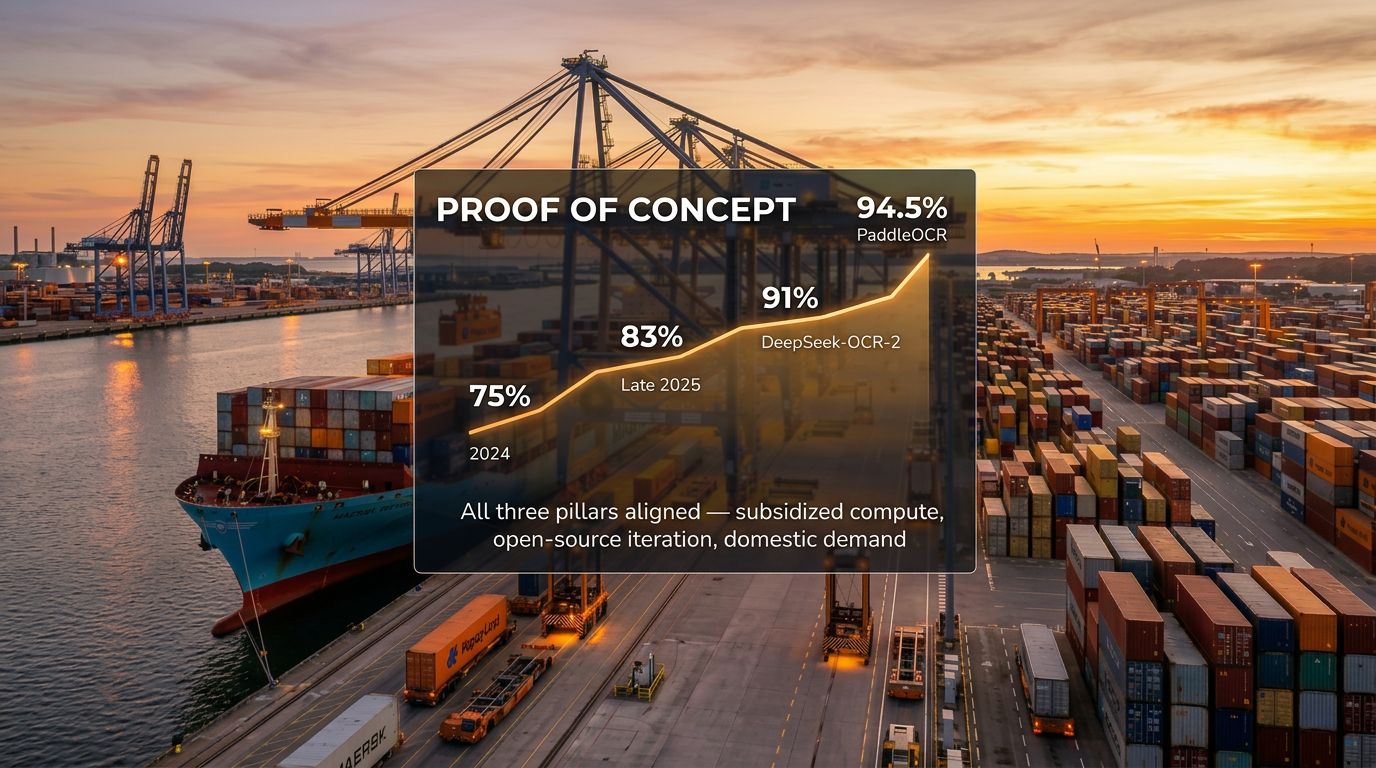
OCR accuracy jumped 11.5 points in a single month
OCR accuracy jumped 11.5 points in a single month
In 2024, the best OCR models hit roughly 75% accuracy on complex documents. By January 2026, Baidu's PaddleOCR-VL-1.5 reached 94.5%. The combination of state compute subsidies, open-source culture, and a massive domestic document-processing market created conditions where Chinese labs dominated a specific AI application faster than anyone else. For the whole-of-nation thesis, it's proof of concept.
Editor's Insight
The OCR case study shows what happens when all three pillars align on a specific vertical: subsidized compute lowers experimentation cost, open source accelerates iteration, and domestic demand provides the training data and market pull.
The EU has Pillar 1 partially. The US has none of the three — its AI leadership rests entirely on private capital and market dynamics.